Reference
A working guide to research peptides, purity and handling
Background reading on what research peptides are, how purity is measured and what responsible handling looks like in a laboratory setting.
What research peptides are, and why purity is the whole story
Peptides are short chains of amino acids — typically between two and fifty residues — that sit between single amino acids and full proteins in size. In biological systems they act as signalling molecules: they bind receptors, trigger cascades and switch cellular behaviour on or off. That specificity is exactly what makes them useful at the bench. A researcher studying the incretin axis, actin polymerisation or telomerase expression needs a tool that engages one pathway cleanly rather than a blunt instrument that perturbs a dozen at once.
Because peptides are produced by solid-phase synthesis, where residues are added one at a time to a growing chain on a resin support, the failure modes are predictable. Incomplete coupling leaves deletion sequences one residue short. Incomplete deprotection leaves fragments carrying protecting groups. Aggressive cleavage from the resin can oxidise methionine or cyclise glutamine. None of those impurities are visible in the vial — a 92% pure lyophilised cake looks identical to a 99.4% one — and all of them can distort an assay result in ways that read as a real biological finding.
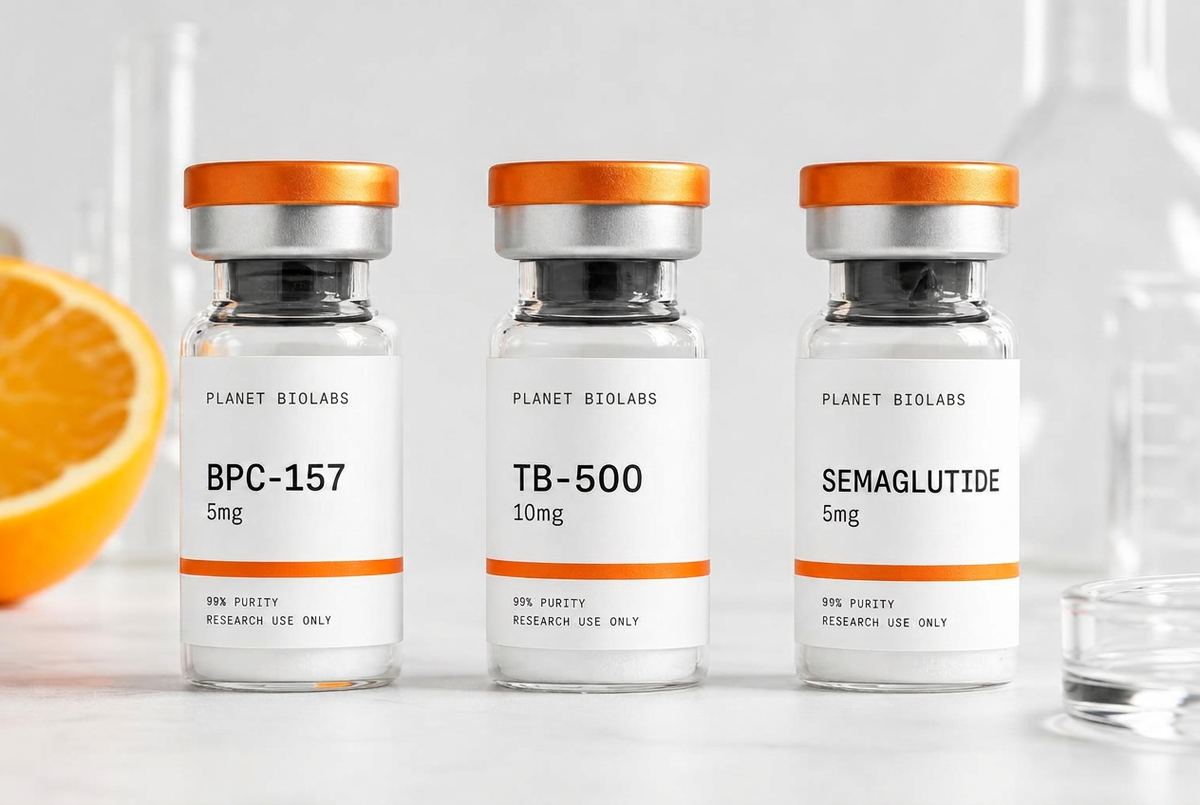
This is why every compound in the Planet Biolabs catalogue carries a published certificate of analysis rather than a self-declared purity figure on the label. The number on the product page is the number the analytical run produced for the specific lot in your vial.
How HPLC and mass spectrometry testing actually works
Two orthogonal methods answer two different questions. High-performance liquid chromatography answers 'how much of this sample is the target sequence?' The sample is pushed through a packed column under pressure; compounds separate by how strongly they interact with the stationary phase, and a UV detector at 214nm records each species as a peak. The area under the main peak, divided by the total area of all peaks, gives the purity percentage. Deletion sequences and truncated fragments show as shoulders or satellite peaks and are counted against the total.
Mass spectrometry answers a different question: 'is the main peak the sequence it is supposed to be?' The sample is ionised and its mass-to-charge ratio measured against the theoretical molecular weight calculated from the intended amino acid sequence. A match within a few daltons confirms identity. A systematic offset usually indicates a missing residue or a retained protecting group. HPLC without MS can certify a very pure sample of the wrong compound; MS without HPLC can confirm the right compound is present without saying how much else is in the vial. Both are required before a batch is released.
Our certificates record the compound, lot number, assay date, purity figure and methods used. They are published to the certificate library before the batch is listed for sale, and the lot number printed on your vial matches the entry you can search there.
Reconstitution, storage and the practical side of handling
Compounds ship lyophilised — freeze-dried into a stable cake under vacuum — because peptides in solution degrade far faster than peptides in the solid state. Lyophilised material tolerates short periods at ambient temperature during transit, which is why tracked next-day dispatch is adequate and dry ice generally is not. On arrival, store the sealed vial at 2–8°C, or in a freezer if the material will sit unused for months.
Before opening, let the vial reach room temperature inside its carton. Opening a cold vial pulls humid air onto the cake and introduces water the lyophilisation process was designed to remove. Reconstitute with bacteriostatic water by directing the stream down the inner wall of the glass rather than into the powder itself, then swirl gently until the solution clears. Do not shake: mechanical agitation and the air-liquid interface it creates will denature and shear the sequence, which shows up as lost activity long before it shows up as visible cloudiness.
Some hydrophobic sequences will not dissolve in neutral bacteriostatic water at all. For those, a small volume of dilute acetic acid lowers the pH, increases the net charge on basic residues and breaks up aggregates; the acidified stock is then diluted to working concentration. Once reconstituted, label the vial with the date, keep it at 2–8°C away from light, and use it within twenty-eight days. The benzyl alcohol preservative in bacteriostatic water is what makes that multi-draw window possible.
Who these compounds are for
Everything listed here is supplied strictly for in-vitro laboratory research by qualified personnel. These are not medicines, they hold no marketing authorisation, and they are not intended for human or veterinary consumption, ingestion, injection or any form of clinical use. Placing an order confirms that the material will be used in a research setting and handled according to your institution's chemical safety procedures.
If you need a specific lot number for continuity across a study, note it in the order comments and we will fulfil from that batch where stock allows, or tell you the nearest available alternative before shipping. For questions on solubility, matched-batch sets or bulk quantities, the London lab team answers the same working day.